
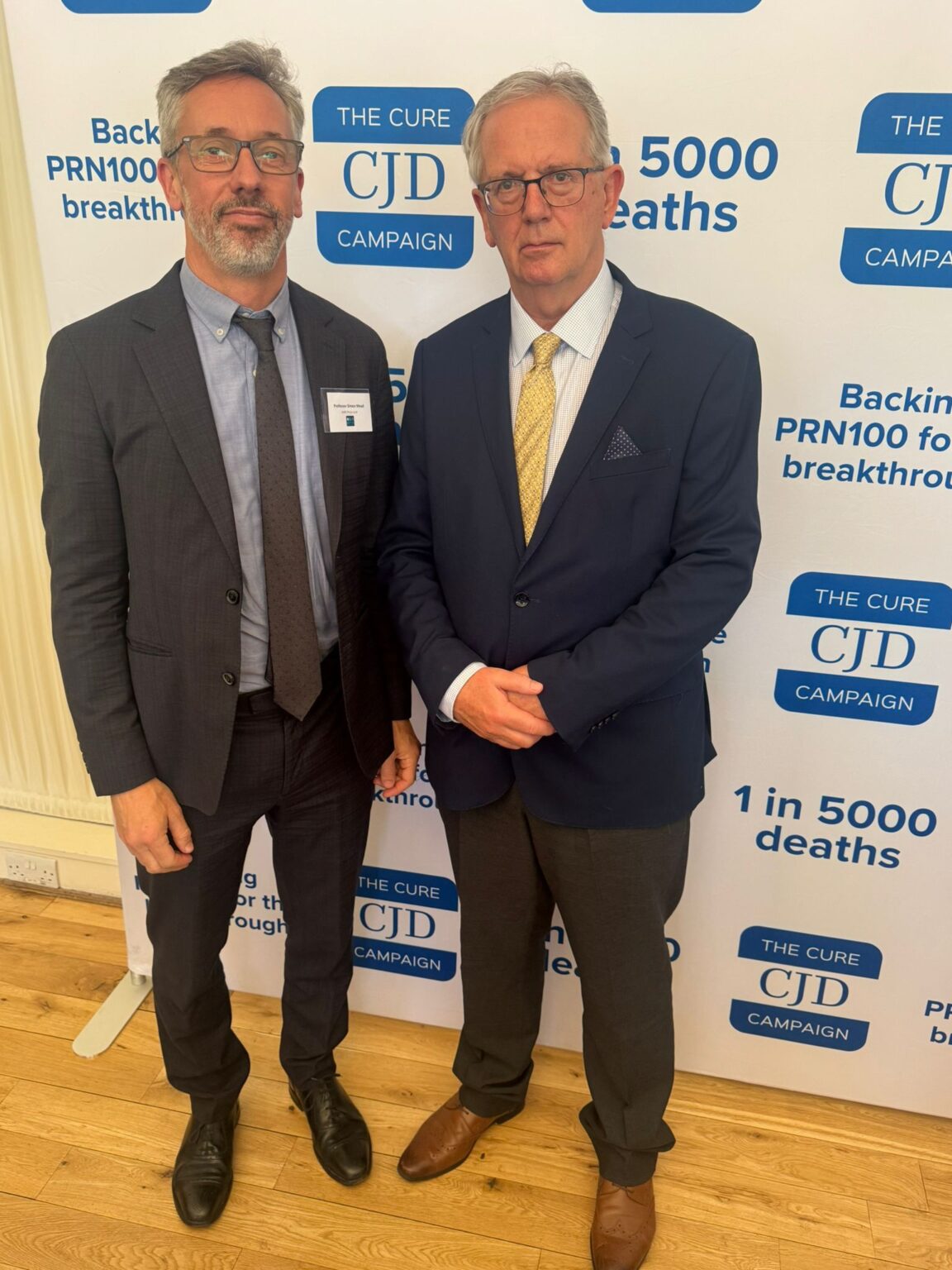
I’ve welcomed news of world leading scientific research at University College in London on the search for a cure to Creutzfeldt-Jakob Disease, known as CJD.
At a recent Parliamentary event for the Cure CJD Campaign, I met with families who have experienced CJD first-hand, as well as Cure CJD’s researchers, policy experts and fellow parliamentarians to hear about work to accelerate progress towards a cure.
Creutzfeldt-Jakob Disease (CJD) is a fatal and rapidly developing degenerative brain disease to which there is currently no cure. Most patients tragically pass away within one year after the onset of symptoms, and some just weeks after diagnosis. CJD causes prion proteins in the brain to become misshapen and stick to each other, which then spread and multiply throughout the brain.
Although little-known to the public, prion diseases account for roughly one in every 5,000 deaths in the UK, while one in 2,000 UK citizens may be carriers of the disease. They are rare but invariably fatal neurodegenerative disorders of the brain, which can remain silent for years before causing rapid and irreversible physical and mental decline, inevitably leading to death.
Now, world-leading scientific research at University College London’s Medical Research Council (MRC) Prion Unit has made a remarkable breakthrough that could finally offer a cure to CJD. Phase 1 of these trials focused on 6 patients with positive results; now Cure CJD is looking to secure the £10 million needed to proceed to PRN100 clinical trial phase II. It is hoped that PRN100 could be used to completely prevent onset of disease in healthy individuals who carry one of the many genetic mutations that cause CJD. Scientists are optimistic that PRN100 could also be used for research for Alzheimer’s disease and possibly other common neurodegenerative diseases.
We are at an incredible moment of hope for the lives of patients, families, carers and those at risk of CJD. Securing this funding of £10 million going forward is crucial for the next phase of clinical trials to establish efficacy. Thanks to the culmination of over thirty years of dedicated scientific research at University College London, the results of these trials could be transformative, not just for patients with CJD but also for other conditions such as Alzheimer’s and Parkinson’s, which share certain “prion-like” disease mechanisms.
I fully support Cure CJD’s campaign to raise funds to enable the work of the MRC Prion Unit at UCL – with numbers like 1 in 5000 deaths from this disease in the UK and the level of suffering it causes, it’s vital that we can turn this hope into a reality.
Photograph with Professor Simon Mead of the MRC Prion Unit at UCL.
